PUBLICACIONES

Prof.Dr. Francisco Eugenio López Guerrero

Ingeniero Mecánico Electricista e Ingeniero en Control y Computación de la UANL Obtuvo el grado de Maestro en Ciencias de la Administración con especialidad en Sistemas en la misma Universidad, durante estos estudios participó en la Universidad Técnica de Hamburgo, Alemania en donde desarrolló su tesis de maestría. Doctor en Ingeniería de Materiales en la Universidad Autónoma de Nuevo León trabajando en conjunto con el Departamento de Materiales y Automatización de la Universidad Técnica de Hamburgo, Alemania. Profesor de tiempo completo de la División de Ingeniería Mecánica de la FIME.

Sugerencias: Prof.Dr.E. Lopez


Integration einer Fertigungszelle in einer erweiterten DAE-Umgebung
Rall, K., Wollnack, J., Fabisiak, B., López, E.
IBM Deutschland GmbH, 1991.

Abstract
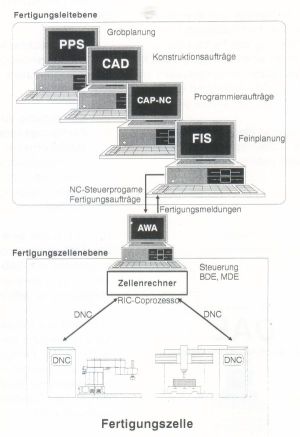
Ziel war die Realisierung einer physikalischen Kopplung von Fertigungskompo-nenten einer Fertigungszelle mit einem Werkstattsteuerungssystem im Rahmen der CIM-Aktivitäten an der Technische Universität Hamburg-Harburg. Ausgangs-punkt dieses Projektes war das neue Softwarepaket IBM DAE (Distributed Automation Edition für OS/2). Für die Realisierung des Projektes wurden zwei wesentliche Punkte bearbeitet:Zellenrechnerkonzept, wodurch die Anwendungsschicht des Zellenrechners spezifiziert wurde und die Einbindung vorhandener Fertigungskomponenten in die DAE-Software, um die Kommunikationsaspekte der CIM-Zelle in DAE zu berücksichtigen.

Key words: CAD/CAM Systeme, CIM-Zentrum, CNC Netze, Robotik, Maschinenprotokolle.


Maquinado de trayectorias en dos dimensiones basadas en pixeles
López, E., Ramírez, F.
Revista Ingenierías vol. III, no. 9, 2000.

Abstract
The Computer-Assisted Design (CAD) and the Computer-Assisted Manufacture (CAM) processes have been presented as a model to ensure high flexibility and accuracy. The complexity of this model implies a long and difficult tteaching-learning process for both students and designers operating the tool machines. This article presents a learner-centered project for engineering students to develop technology by manufacturing 2D products without precision but with rapid fabrication response using commercial computere programs and appropiate interface adaptions.

Key words: CAD/CAM, machining, interpolation, CNC.


Improvement of aluminium parts machining process in a numerical control milling machine
Zambrano, P., Escamilla, I., López, E.
International Materials research Congress 2001. Academia Mexicana de Ciencia de Materiales, A.C., 2001.

Abstract

In processing parts by numerical control it is very important to optimize the machinability of these ones, this could turn out in to higher production with good quality and low cost. To achieve this, there are some parameters that must be taken into account, such as tooling and workpiece materials, cutting speeds and feed rates.
A critical point becomes to determine the feed and cutting speeds, if any of both is increased while the other one stays constant, the machining time could be lower with the excessive tool ware.
The aim of the present work is to obtain and improvement in the machining process of alluminium parts by numerical control milling. The first step was to find the optimal path by digitalized points that conduct to this one. With the digitalized points a numericla control code was obtained and the process variables were choosen, then an interactive matrix was set in order to find the speeds that fulfill the best mechanical properties and surface finishing of the work piece. Each piece was mechanically characterized and microstructures were studied.

Key words: CAD/CAM, alluminium milling machining, CNC code optimization.

Generación de código de maquinado en 3D para modelos basados en mallas
López, E., Colás, R., Rall, K., Ramírez, F.
Revista Ingenierías vol. IV, no. 10, 2001.

Abstract
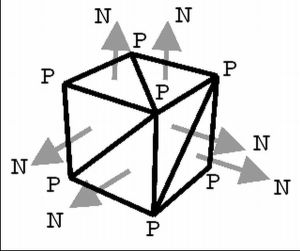
The evolution of CAD/CAM (computer aided design / computer aided manufacturing) systems has enabled more complex parts to be modelled. Today, most of the modelled parts are more than grouped geometric primitives (points, arcs, lines, etc), but complex shapes defined trough three dimension surfaces, that can not be directly processed by the tool-machine control. Hence, there is a need to create methods to allow the machining process. This article presents an approach to generate numerical control code (NC code) from 3D meshes geometries for a 2 ½ axis milling machine. First the theoretical constrains of 3D machining are explained. Then a method based on mesh geometries and unit vectors is presented. The results of this method were obtained by means of computer simulations. Finally, a series of proposals for the improvement the proposed method are presented.

Key words: CAD/CAM, geometric modelling machining, interpolation, CNC.

Maquinado de una sucesión de curvas
López, E., Colás, R., Rall, K., Ramírez, F.
Revista Ingenierías vol. IV, no. 11, 2001.

Abstract
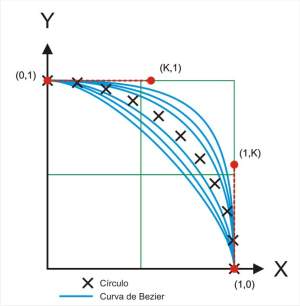
Many objects in the nature are inherently of soft and continuous geometry, and so much the computers to model them as well as the machines that manufacture objects starting from those models should be able to reproduce such geometries. The computer aided design and manufacturing systems (CAD/CAM), the high quality typography, the artistic sketches and the movement of a cinema camera are examples of these conditions of soft and continuous bend. A technique of modeling faithful to the reality defines curves with different characteristic each one whose bend follows better the contour of the object that models. This article presents the problem of the machinning of geometries in a plane with geometric continuity, and it proposes a solution. At the same time reference is made to the different mathematical aspects of the problem.

Key words: CAD/CAM, geometric modelling, Bezier, NURBS, machining, interpolation, CNC.

Modelaje de la viruta en el proceso de maquinado. Parte I
López, E., Ruiz, M., Colás, R.
Revista Ingenierías vol. IV, no. 13, 2001.

Abstract
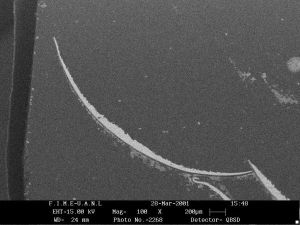
Several survey on machinability has been done, first to understand the process, and then to optimize and improve it under a particular criterion. In a machine-tool system, the role of the NC-code is critical, as it concerns not only the tool paths but also the cutting values. The optimal code is determined not only by the machine's control, but also the geometric conditions and the materials involved both in the tool and part to be machined.
This first article presents a method to study the relationship between the parameters of the NC-code by means of a mathematical model. Experimental results allowing the validation of the method are presented.

Key words: geometric modeling, machining, machinability, CNC.

Modelaje de la viruta en el proceso de maquinado. Parte II. Validación experimental
López, E. Ruiz, M.
Revista Ingenierías vol. V, no. 14, 2002.

Abstract
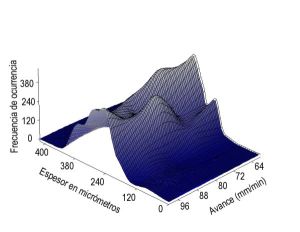
Since the study of machinability must be done by means of a particular criterium, the chosed for this work was the analysis of the chip geometry. In the first article of this serie was exposed also the mathematical model of the tool movement, and the influence on the machined surface.
This second article presents the experimental results of the study on the relationship between the parameters of the NC-code and chip thickness by means of statistik. This should allow part of the validation of the method presented in the first article .

Key words: geometric modeling, statistik, machining, machinability, CNC.

Evaluación de las condiciones de maquinado por medio de emisiones infrarrojas
López, E. Ruiz, M. Méndez, L.
Revista Ingenierías vol. V, no. 16, 2002.

Abstract
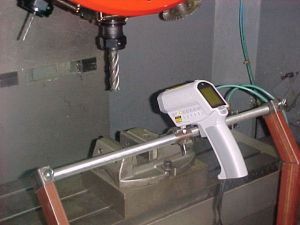
Requirements of high-quality standards have become essentials in manufacturing technology. Thus, the conditions of the process must be related with the surface finish achieved.
One of those conditions is the thermal energy generated during the machining process. This energy can be measured in terms of temperature increments and depends of the feed, depth of cut and tool cutting speed.
As a complement for the series of experiments exposed in the preceding articles this work presents the theoretical fundamentals and experiments based in the effects of tool feed on the temperature behavior during the machining process. .

Key words: thermal energy, cutting speed, tool feed.


Evaluación de las condiciones de maquinado por medio de emisiones infrarrojas
López, E. Ruiz, M. Méndez, L.
Cartel en el VII Simposio de Ciencia y Tecnología, SEP-CONACyT 2002.

Resumen
En la actualidad los procesos de maquinado requieren de geometrías y acabados precisos que se encuentren dentro de las normas estandarizadas. Existe un número considerable de variables que intervienen en los procesos de manufactura, y mas específicamente en el proceso de remoción de material. Para comprender el alcance de estas variables es necesario tener un conocimiento cualitatuvo y cuantitativo de los parámetros que las rigen y las posibles interacciones entre ellos. A primera instancia, debe tenerse en cuenta las magnitudes de energía utilizada para la remoción de material. Esta energía está determinada por las fuerzas y velocidades en el plano de corte.Teniendo en cuenta que de la energía utilizada para el corte de material cerca del 98% se convierte en energía térmica, el conocimiento de la cantidad de calor que se genera en el proceso es determiante para poder establecer los rangos admisibles de las variables que producen esta generación de energía. El presente trabajo propone la metodología para determinar estos rangos de energía durante el maquinado en términos de temperatura, y obtener la relación que guardan con la velocidad de corte, para encontrar los parámetros óptimos del proceso de remoción de material.


Caracterización de superficies maquinadas por medio de parámetros de rugosidad
López, E. Cavazos, R. Delgado, M.
Cartel en el VII Simposio de Ciencia y Tecnología, SEP-CONACyT 2002.

Resumen
En la comprensión de los procesos que generan superficies es crucial la relación entre la calidad de la superficie y su comportamiento funcional. Esta comprensión puede lograrse a través de una técnica adecuada de caracterización y síntesis de las superficies. A continuación se plantea una metodología que caracteriza las superficies maquinadas.
Este trabajo centra su base en caracterizar la superficie maquinada identificando las componentes de la huella de la herramienta y las características de rugosidad asociadas a las propiedades del material al ser maquinado.


Caracterización de superficies maquinadas por medio de parámetros de rugosidad
López, E. Ruiz, M. Delgado, M.
Foro de Investigación UDEM 2002.

Resumen
Las superficies de maquinado generadas por medio de los procesos de arranque de viruta exhiben características topográficas que juegan un papel fundamental en el desempeño de la funcionalidad del producto, y pueden estar determinadas por la fricción, lubricación, estética, etc.
Algunos de los comportamientos funcionales de la calidad de las superficies maquinadas pueden lograrse solamente bajo su caracterización.
Los métodos para analizar superficies se basan en su caracterización por medio de medidas tradicionales (altura promedio, distancia de pico a pico máxima, etc), por medio de transformaciones matemáticas (onduletas o "wavelets", análisis de frecuencia, etc) y geometría de fractales, entre otros. La caracterización en el dominio de la frecuencia se logra utilizando un análisis en espacio para posteriormente transformar las características en el dominio de la frecuencia.
Una vez conseguido esto, es posible: 1)encontrar la influencia directa de los parámetros de corte en la calidad superficial 2)mejorar los valores de corte 3)encontrar eventuales fallas de maquinado como vibraciones, sujeciones, etc., para una situación de maquinado dada.

Palabras clave: rugosidad, calidad superficial, maquinado, método de espectro de frecuencias.
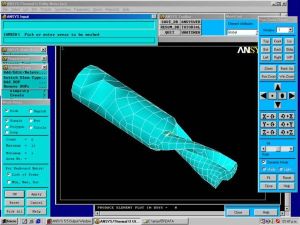

Simulación por elemento finito de la distribución de la temperatura en la herramienta durante el proceso de fresado
López, E. Méndez, L., Ramírez, F.
Gran Congreso Anual AMMIME-AI-SOMIM 2002 Sept. 2002.

Abstract
One of the conditions in the machining process is the thermal energy generated during the process. This energy can be measured in terms of temperature increments and depends on the feed, depth of cut and tool cutting speed. This work presents a finite-element simulation based on experiments on the effects of tool feed over the temperature behavior during the milling process.

Key words: FEM, temperature, infrared sensors, machining, milling.
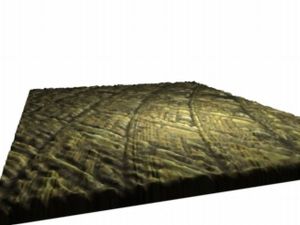

Caracterización de superficies maquinadas por medio de parámetros de rugosidad
López, E. Cavazos, R. Delgado, M.
Revista Ingenierías vol. VI, no. 18, 2003.

Abstract
The proper functioning of a machined part is to a large extend dependent on the quality of its surface. The term "surface quality'' includes not only the dimensional qualities of the surface, but also the material properties, as hardness, color, and metallurgical structure. The dimensional quality having to do with the surface irregularities is known as the "roughness surface". The importance of the roughness of the final finish has long been appreciate. The urgent need for high production and low cost has developed techniques in wich roughness control is of proven importance not only in the finished piece but on the intermediate finishes as well. This work presents a result of a experiments series based in the relationship between the feed rate and the roughness measured in material's machined cut.

Key words: roughness, surface, machining.


Caracterización de superficies maquinadas por medio de parámetros de rugosidad
López, E., Flores, R., Delgado, M., Ruiz, M.
Cartel en XXIII Congreso Nacional de la Sociedad de Superficies y Vacío, Ago. 2003.

Resumen
En la comprensión de los procesos que generan superficies es crucial la relación entre la calidad de la superficie y su comportamiento funcional. Esta comprensión puede lograrse a través de una técnica adecuada de caracterización y síntesis de las superficies. A continuación se plantea una metodología que caracteriza las superficies maquinadas.
Este trabajo centra su base en caracterizar la superficie maquinada identificando las componentes de la huella de la herramienta y las características de rugosidad asociadas a las propiedades del material al ser maquinado.
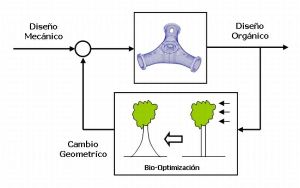

Reducción de la concentración de esfuerzos para piezas de fundición por medio del método de elementos finitos utilizando algoritmos de crecimiento biológico
Ramírez, F., López, E. Ortiz, U., Guzmán, R.
IX Congreso Anual SOMIM 2003 vol. VI, pág. 25, Sept. 2003.

Abstract
The geometries created by the nature are often used as base in the computer geometric modeling and they are applied in areas like biomechanics. Other natural behaviors are support the engineers to find better designs that have improved functionality. This work presents the use of algorithms of biological growth embed in a finite element environment in order to modify the shape of foundry pieces, minimizing their maximal stress. Initially the analysis of the shape using the method of conventional finite element is presented. Later the same geometries are optimized with algorithms of biological growth. Finally the results of both cases are compared.

Key words: Finite element, bio-design, notch stress, biological growth, shape optimization, B-Splines.
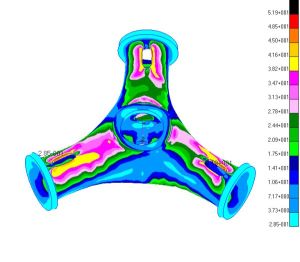

Diseño óptimo de elementos mecánicos usando algoritmos de crecimiento biológico
Ramírez, F., López, E. Ortiz, U., Guzmán, R.
Revista Ingenierías vol. VII, no. 22, 2004.

Resumen
En el diseño de componentes mecánicos se encuentran frecuentemente cambios de geometría no uniformes que junto con las inclusiones y defectos dentro de los materiales pueden dar lugar a un incremento en el valor de los esfuerzos. La distribución de estos esfuerzos en piezas con geometría compleja se puede predecir y es deseable optimizar las zonas en donde estos se concentran. Este trabajo presenta el uso de algoritmos de crecimiento biológico en un ambiente de elemento finito para modificar geometrías modeladas con matemática de superficies libres y curvas splines para poder alcanzar la distribución uniforme y optimizada de esfuerzos que se encuentra en la naturaleza. Convirtiendo así al diseño mecánico en un "diseño biológico".

Palabras clave: elemento finito, crecimiento biológico, concentración de esfuerzos, superficies libres, optimización de la forma.

Optimización geométrica con criterio de crecimiento biológico
para la reducción de la concentración de esfuerzos en uniones

Ramírez, F., López, E. Ocañas, J.
X Congreso Anual SOMIM 2004 Sept. 2004.

Abstract
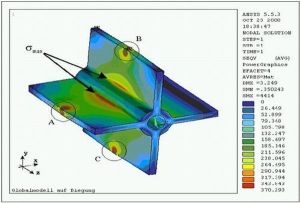
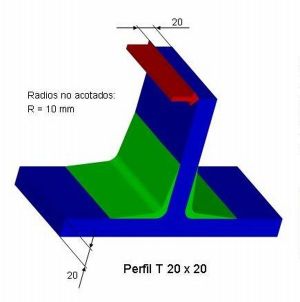
In the production of machines, the mechanical design of their structures must have as the highest priority the functional needs. If the material of the component has been previously determinated, the geometry is conditioned by an adequate stress distribution. This work presents a geometric optimization method for a T union used in a machine structure. The union was analyzed under a load situation with a finite element system. A new shape was found with a optimal stress distribution with a biological growth optimization criteria.

Key words:Finite element, bio-design, notch stress, biological growth, free form surfaces, shape optimization.

Modelado de superficies maquinadas utilizando una metodología basada en capas
E. López, M. Ruiz, F. Ramírez, J. de la Garza, J.L. Castillo
XI Congreso Internacional Anual SOMIM, Sept. 2005.

Abstract
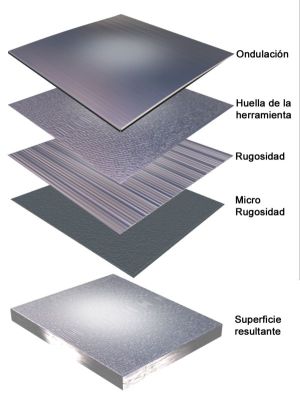
The surface characteristics of a machining part in the functional performance of it have a great effect. In the case of elements of mechanisms the surface influences in the behavior of the parts in contact, while in the case of injection molds, this influence is not only present in the aesthetic appearance of the final product, but rather it can be decisive in phases of the manufacturing process. In previous works [LOP01, LOP02a, LOP02b, LOP03] roughness analysis of frequency has been presented to determine the influence of the machining parameters in the surface of products, and factors have been identified of having of direct influence in the superficial quality. This work presents a method to model surfaces based on layers, using to generate each layer the most significant values from the ruggedness in different ranges, in such a way that is possible to produce synthetic surfaces and with it is expected to predict characteristic of surface for machining situations given.

Keywords: roughness, spectrum of frequencies, modeling of surfaces, free surfaces, form optimization.

Optimización geométrica con criterio de crecimiento biológico
para la reducción de la concentración de esfuerzos
en placas con perforaciones transversales
Ramírez, F., López, E. Romero, I.
XI Congreso Internacional Anual SOMIM, Sept. 2005.

Abstract
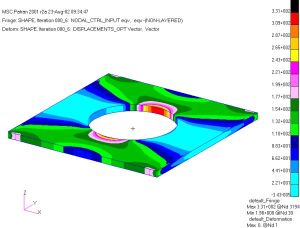
The design of machines normally involves structural members with non uniform cross sections that added to material internal defects might cause an increase in stress concentrations. This work presents a geometric optimization method for a flat bar with a transverse hole in tension. The flat bar was analysed under a load situation with a finite element system. A new shape was found with an optimal stress distribution with a biological growth optimization criteria.

Keywords: Finite element, bio-design, notch stress, biological growth, design of machines, shape optimization.

Diseño de un instrumento para la captura de geometrías 3D
con aplicación en la manufactura de productos

F. Ramírez, E. López, I. Romero, J. de la Garza, J.L. Castillo
Revista de la Sociedad Mexicana de Ingeniería Mecánica. Vol. 2 No. 3, Año 5 (2006) p. 101-110 ISSN1665-7381

Abstract
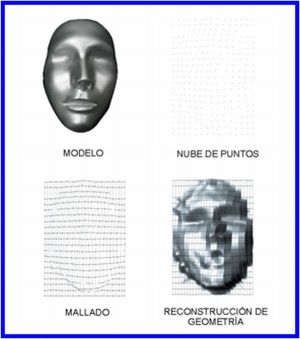
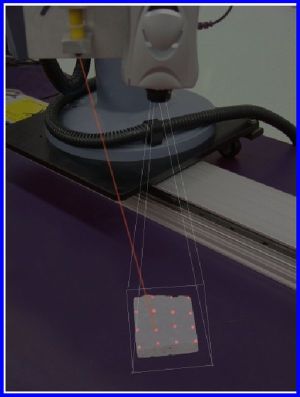
The 3D scanning has become an useful tool in the development of products because of the increasing use of reverse engineering techniques. It has many advantages related to reducing time and costs with a good accuracy level. This document presents a system to reproduce 3D geometries from images captured with a measuring instrument based on a digital camera and a laser pointer, manipulated through a robot arm. This work includes the calibration of the measuring instrument and the reconstructed surface of the object in 3D coordinates.

Keywords: 3D scanner, measuring by triangulation, reverse engineering, error estimation, 3D reconstruction.


Diseño de un instrumento para la captura de geometrías 3D
con aplicación en la manufactura de productos

F. Ramírez, E. López, I. Romero, J. de la Garza, J.L. Castillo
Revista Ingenierías vol. X, no. 34, Enero 2007 (reprint)

Abstract
The 3D scanning has become an useful tool in the development of products because of the increasing use of reverse engineering techniques. It has many advantages related to reducing time and costs with a good accuracy level. This document presents a system to reproduce 3D geometries from images captured with a measuring instrument based on a digital camera and a laser pointer, manipulated through a robot arm. This work includes the calibration of the measuring instrument and the reconstructed surface of the object in 3D coordinates.

Keywords: 3D scanner, measuring by triangulation, reverse engineering, error estimation, 3D reconstruction.


Diseño e implementación de un control mecatrónico de estructura abierta
para una máquina-herramienta

A. Cayetano, E. López, A. Castillo, A. Avila, J. Herrera
XIII Congreso Internacional Anual SOMIM
p. 121, sept. 2007. ISBN 968-9173-01-4

Abstract
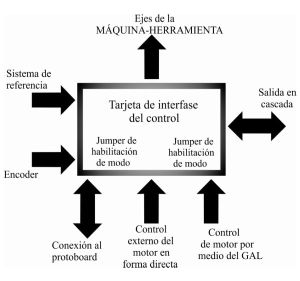
The versatility of a machine-tool is directly influenced by the mechanical construction, the user-machine interaction and its control. These features are only determined by the fabricant making it impossible for the user to achieve complex applications that require some type of additional funcionality from the machine. the present works presents the design and implementatin of an open structurecontrol able to adapt to different user needs. The technological implementation is based on a system conformed by a Motorola MEV912B32 micromodule and an own control interface based on state changing devices based on operation frecuencies. The development includes the verification of the systems constants for the implementation of a command system that allows the input of commands from differents devices. The position, velocity and performance test results indicate that the control is linear and allos knowing the operation range.

Keywords: Tool-machine, step motor control, open structure, machining, microcontroller.


Evaluación de características dimensionales y de color
de piezas producidas en prototipos rápidos

E. López, F. Ramírez, J. de la Garza, A. Castillo
XIII Congreso Internacional Anual SOMIM
p. 66, sept. 2007. ISBN 968-9173-01-4

Abstract
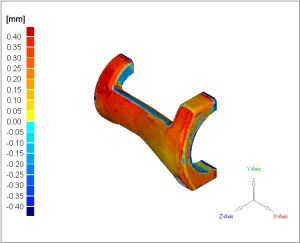
Rapid prototyping (RP) has become a useful tool in product design. It allows to test the product geometry before the model is turned to the production. Different technologies exist, each with advantages like speed, precision, color fidelity, material cost or some basic mechanical properties.This work presents the evaluation of the geometrical and color properties of the prototypes from a RP machine.
This evaluation was done with a coordinate-measuring machine (CMM). The results show the construct deviation, allowing the error correction before the model was sent to build.

Keywords: rapid prototyping, 3D scanninggeometric desviation, color analysis, spectrocolorimetry, reverse engineering, error estimation.


Elaboración de bustos por medio de digitalización 3D y prototipos rápidos
E. López, I. Márquez, D. Franco, F. Ramírez
XIV Congreso Internacional Anual SOMIM
p.836-846, sept. 2008. ISBN 968-9173-01-4

Abstract
The made of bust, sculptures and statues is a work where the accuracy and similarity with the real character is the most important issue. Although the technology could not replace the originality from a sculptor, the new reverse engineering technology allows not only to made an accurate sculptures, but also allows to mix different sort of geometric modeling. This work presents the reverse mechanical engineering method applied to build a bust by means of different processes. It includes capture, edition and fabrication of geometries. It explains also the procedures to handle point clouds, photorealism and rapid prototyping printing.

Keywords: reverse engineering, 3D scanning, digital sculptures, geometric deviation, rapid prototyping.


Digitalización 3D como herramienta en la manufactura de calzado deportivo
E. López, F. Ramírez, A. Ávila
XV Congreso Internacional Anual SOMIM
p.137-146, sept. 2009. ISBN 968-9173-01-4

Abstract
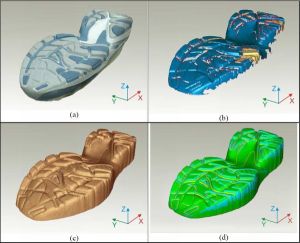
In order to be attractive for the end user, the design of consum products involves not only the functional conditions, but also the esthetic properties. In the particular case of sport shoes, the geometric complexity of the sole is a challenge for the designer, and the result must be a product with visual attraction, use comfort, good friction and wear conditions.

This work presents the reverse engineering methodology applied to the manufacture of a sport shoe sole. It includes only the solution of the geometric problem, through the mix of several technologies: scanning, editing and manufacturing of geometric models. It focuses on the processes: 3D scanning, point cloud processing, virtual reality production and rapid prototyping.

Keywords: reverse engineering, 3D scanning, footwear, geometric shoe shape, rapid prototyping.


Relación de la geometría de elementos mecánicos con el cambio de forma en la naturaleza
como criterio de diseño

E. López, F. Ramírez, I. Márquez, J. de la Garza, A. Castillo
XVI Congreso Internacional Anual SOMIM
p.xxx-xxx, sept. 2010. ISBN 968-9173-01-4

Abstract
The need to improve mechanical elements as well as to shorten the cycles of design has led to the exploration of alternatives that solve the problems raised by different needs. In the last decades, diverse researchers have observed in the nature the ability of natural structures to resist the loads to which the environment submits them.

In this work it is obtained from nature a model of "geometric natural optimization" which allows us to verify the application efficacy in the design of mechanical elements, verifying the levels of stress before and after modifying their geometry. Also validated are the arguments of C. Mattheck, which establish that the biological structures develop geometries that allow them to have uniform levels of stress in all their structure..

Keywords: Geometric optimization, natural forms, geometric design, homogeneous stress.


Diseño y construcción de un robot hexápodo
E. López, J. Betancourt, H. Martínez, D. Ancira, F. Ramírez
XVII Congreso Internacional Anual SOMIM
p.310-319, sept. 2011. ISBN 978-607-95309-5-2

Abstract
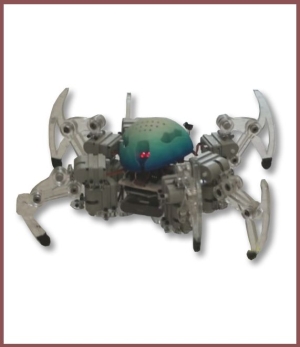
The design of robots with biological characteristics has gained area as the electronics and the supply of energy diminishes their size. The applications include from the academic to those that demand tasks in irregular or dangerous
area for the human being. This work presents the design and the construction of a hexapod robot, during which it was considered the integration of the mechanical and electronic design, as well programming in a mechatronic system. At the same time includes solutions with last generation engineering tools as CNC, rapid prototypes, geometric design and analysis with CAD, software engineering, wireless communication and open structure of programming.

Keywords: walking robot, hexapod robot, Movement synchronization, biologic design, rapid prototyping.


Propuesta de transición geométrica para la mejora de desempeño en uniones de fundición tipo "T"
F. Ramírez, E. López, A. Ávila, J. Castillo
XVIII Congreso Internacional Anual SOMIM
p.1157-1165, sept. 2012. ISBN 978-607-95309-6-9

Abstract
The mechanical design of components must have as the highest priority the functional needs. If the material of the component has been previously determined, the geometry is conditioned by an adequate stress distribution.
This work presents an experimental geometric improvement method for a T union. Different transitions were proposed, and were analyzed under a load situation with finite element software. A better stress distribution was found, using dispersion versus area growth criteria.

Keywords: Finite element, notch stress, free form curves, shape optimization.


Diseño y construcción de un brazo digitalizador como máquina de coordenadas manual para la captura de objetos 3D
E. López, N. Garza, F. Ramírez
XIX Congreso Internacional Anual SOMIM
p.269-279, sept. 2013. ISBN 978-607-95309-9-0

Abstract
In manufacturing, the geometric reconstruction and measurement plays a key role. In the last ten years the 3D technology has become more popular, but the market demands such technology to be cheaper, faster and easier to use.


This work presents the design and construction of a measurement arm, to be used as a 3D scanner. The work also describes the relation between ideal design and natural production deviations. For the kinematic calibration 3D transformations were used. The form calibration is achieved through pattern measurement experiments. As preliminary result 2D scanned objects in R3 are presented.

Keywords: Coordinate Measuring Machines, 3D scanner, reverse engineering.


Mejora estructural de un soporte tipo balancín a través de un análisis topológico
F. Ramírez, E. López, C. Salazar
XIX Congreso Internacional Anual SOMIM
p.334-339, sept. 2013. ISBN 978-607-95309-9-0

Abstract
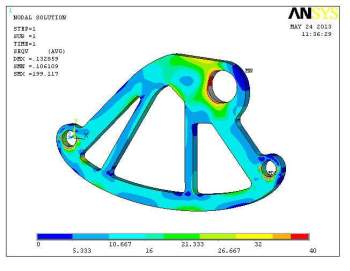
This work presents the implementation of a topology optimization method to minimize the strain energy in statically loaded structures. The case study is a carrier and rocker lever used in automotive suspensions. Improvement proposal is subject to minimize the use of material. The resultant design concept of the process is subjected to a machinability study. Finally performed geometric modification of the structure to manufacture using as criteria homogeneous stress distribution. The structure was simulated using the finite element method.

Keywords: Finite element, material distribution, topology optimization, light construction.


Diseño y construcción de un brazo digitalizador para la captura de geometrías
Francisco Eugenio López Guerrero, Pedro Nicolás Garza Patrón, Francisco Ramírez Cruz, Javier De la Garza Salinas
Revista Ingenierías vol. XVII, no. 63, Abril 2014 (reprint)
p.45-57, ISSN 1405-0676

Abstract
In manufacturing, the geometric reconstruction and measurement plays a key role. In the last ten years the 3D technology has become more popular, but the market demands such technology to be cheaper, faster and easier to use.

This work presents the design and construction of a measurement arm, to be used as a 3D scanner. The work also describes the relation between ideal design and natural production deviations. For the kinematic calibration 3D transformations were used. The form calibration is achieved through pattern measurement experiments. As preliminary result 2D scanned objects in R3 are presented.

Keywords: Coordinate Measuring Machines, 3D scanner, reverse engineering.


Diseño de una interfaz para la producción de fisiogramas en el espacio R3 de un robot
E. López, H. Martínez, R. Almaguer, A. García
XX Congreso Internacional Anual SOMIM
p.899-911, sept. 2014. ISBN 968-9173-01-4

Abstract
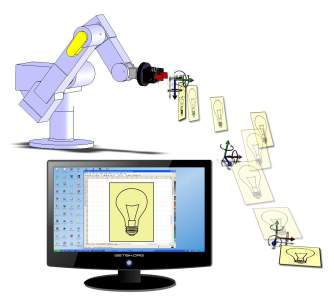
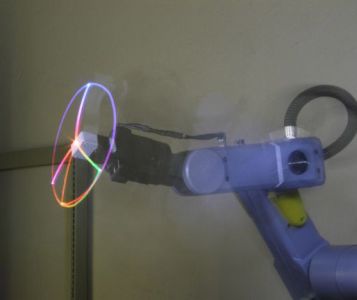
A physiogram or light painting is a photographic technique in which exposures are made by moving a light source (or the camera). This work presents the design and construction of a interface for physiograms made with a robot equipped with a RGB LED. The LED is controlled with a inertial measurement unit (IMU), and the lightcolor changes with the robot´s wrist angle. The trajectories of the robot are drawn in a commercial CAD program. The interface includes a shutter camera control for the robot, and all geometric transformations needed to fit the CAD files in the R3 robot workspace. As result some physiograms and clip-arts are presented.


Keywords: light painting, robot, inertial measurement unit, remote camera shutter.


Diseño de una interfaz para la producción de fisiogramas en el espacio R3 de un robot
E. López, H. Martínez, R. Almaguer, A. García
Revista Ingenierías Año XVIII, No. 69, Octubre - Diciembre 2015
p. 6-17. ISSN 1405-0676

Abstract
A physiogram or light painting is a photographic technique in which exposures are made by moving a light source (or the camera). This work presents the design and construction of a interface for physiograms made with a robot equipped with a RGB LED. The LED is controlled with a inertial measurement unit (IMU), and the lightcolor changes with the robot´s wrist angle. The trajectories of the robot are drawn in a commercial CAD program. The interface includes a shutter camera control for the robot, and all geometric transformations needed to fit the CAD files in the R3 robot workspace. As result some physiograms and clip-arts are presented.


Keywords: light painting, robot, inertial measurement unit, remote camera shutter.


Cureta para desbridación de biopelícula
Sánchez, Vilches, Cesaña, Meza, Ramos, González, Pérez, Uresti, López, Guzman, Mendoza, Acosta
Instituto Mexicano de la Propiedad Intelectual.
Solicitud expediente MX/u/2016/000228, folio MX/E/2016/038632.

Abstract
Pendiente.


Keywords: .


Evaluación de condiciones de maquinado por medio de emisiones infrarrojas
F. Eugenio López G., Miguel A. Ruiz S., Lionel S. Méndez P.
Revista Ingenierías Año XX, No. 77, Octubre - Diciembre 2017
p. 18-23. ISSN 1405-0676

Abstract
Requirements of high-quality standards have become essentials in manufacturing technology. Thus, the conditions of the process must be related with the surface finish achieved.
One of those conditions is the thermal energy generated during the machining process. This energy can be measured in terms of temperature increments and depends of the feed, depth of cut and tool cutting speed.
As a complement for the series of experiments exposed in the preceding articles this work presents the theoretical fundamentals and experiments based in the effects of tool feed on the temperature behavior during the machining process. .

Key words: thermal energy, cutting speed, tool feed.


Determinación del error funcional de un prototipo digitalizador 3D utilizando
patrones de calibración

Fco. Eugenio López G., Juan Diego Rivas Salinas, Francisco Ramírez Cruz
REVISTA INGENIERÍA MECÁNICA TECNOLOGÍA Y DESARROLLO SOMIM
Vol. 6 No. 3 (2018) p.095-106, sept. 2018. ISSN: 2448-5837

Abstract
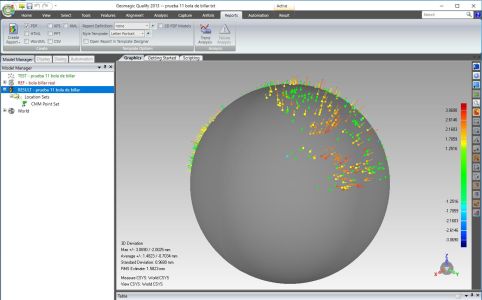
This paper describes a strategy used to calculate the estimation error in curves and surfaces fitting from the ISO 10360-6 standard for measuring machines and 3D digitizers, using the least squares criterion. The algebraic steps for the determination of the equations and calculation algorithms for the line case and a plane are detailed, as well as the case of a circle and a sphere. The plane and sphere entities are used as standard objects for the error estimation of a digitizer prototype developed by the authors. The results found yielded an acceptable degree of certainty in the digitizer for some applications. The present work describes an error estimation strategy for curves and surfaces fitting selected from the ISO 10360-6 for measurement machines and scanners 3D.


Keywords: 3D Scanner, Curve and surface fitting, Measurement machines, ISO 10360-6, calibration object, Error estimation.


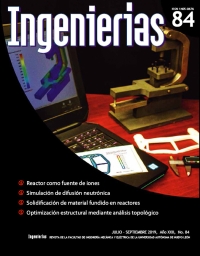
Optimización estructural del codo de una prensa mecánica mediante análisis topológico
Francisco Ramírez Cruz, Héctor Alfonso García Mendoza, Fco. Eugenio López Guerrero, Francisco Javier De la Garza Salinas
Revista Ingenierías Año XXII, No. 84 , Julio - Septiembre 2019
p. 43-55. ISSN 1405-0676

Abstract
This work presents the development of a topological optimization method based on a finite element model to maximize the deformation energy generated on the working structure of the elbow of a mechanical press. The purpose is to minimize the amount of material, maximize stiffness, and provide information for its redesign for its fabrication. The results an increase of 57.89% in the safety factor. Likewise, the maximum stress was minimized by 37.86%, and the improvement in volume of the component was 11.66%.


Keywords: Topological optimization, deformation energy, finite element.


Cureta para desbridación de biopelícula
Antonio Sánchez Uresti; José Félix Vílchez Cavazos; Víctor Javier Cesaña Báez;
Cristopher Emmanuel Meza Cruz; Mario Daniel Ramos Cuevas; Jesús Eduardo González Gómez;
Eric Alberto Pérez Lorea; Rodolfo Estuardo Uresti Bustos; Francisco Eugenio López Guerrero;
Santos Guzmán López; Oscar Fernando Mendoza Lemus; Carlos Alberto Acosta Olivo

Secretaría de Economía, Instituto Mexicano de la Propiedad Industrial - 11 de Abril, 2019
Título de Modelo de Utilidad No. 4044

Abstract
El registro de referencia se otorga con fundamento en los artículos 1º, 2º fracción V, 6º fracción III, y 59 de la Ley de la Propiedad Industrial.
De conformidad con el artículo 29 de la Ley de la Propiedad Industrial, el presente registro tiene una vigencia de diez años improrrogables, contada a partir de la fecha de presentación de la solicitud y estará sujeta al pago de la tarifa para mantener vigentes los derechos.
Quien suscribe el presente título lo hace con fundamento en lo dispuesto por los artículos 6º fracción III, 7º BIS 2 y 59 de la Ley de la Propiedad Industrial; artículos 1º, 3º fracción V inciso a), sub inciso iii), 4º y 12º fracciones I y III del Reglamento del Instituto Mexicano de la Propiedad Industrial; artículos 1º, 3º, 4º, 5º fracción V inciso a), sub inciso iii), 16 fracciones I y III y 30 del Estatuto Orgánico del Instituto Mexicano de la Propiedad Industrial; 1º, 3º y 5º inciso a) y antepenúltimo párrafo, del Acuerdo que delega facultades en los Directores Generales Adjuntos, Coordinador, Directores Divisionales, Titulares de las Oficinas Regionales, Subdirectores Divisionales, Coordinadores Departamentales y otros subalternos del Instituto Mexicano de la Propiedad Industrial.
El presente oficio se signa con firma electrónica avanzada (FIEL), con fundamento en los artículos 7 BIS 2 de la Ley de la Propiedad Industrial; 3o de su Reglamento, y 1 fracción III, 2 fracción V, 26 BIS y 26 TER del Acuerdo por el que se establecen los lineamientos para el uso del Portal de Pagos y Servicios Electrónicos (PASE) del Instituto Mexicano de la Propiedad Industrial, en los trámites que se indican..


Keywords: Cureta de biopelícula, Secretaría de Economía, IMPI, Premio UANL a la Invención.


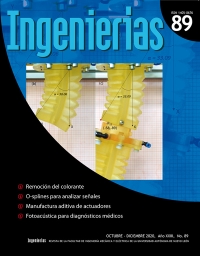
An agile multi-body additively manufactured soft actuator for soft manipulators
Jorge Morales, Francisco Ramírez Cruz, Francisco Eugenio López Guerrero
Revista Ingenierías Año XXIII, No. 89, Octubre - Diciembre 2020
p. 14-27. ISSN 1405-0676

Abstract
With the introduction of collaborative robots in production environments, the harm to workers by using traditional robots with rigid links is inherent. A new generation of robots made from flexible soft materials that decreases collision danger by self-deforming actions has been proposed as a promising solution for the human-robot collaboration environments. Recently, by the development of additive manufacture of elastic soft materials, new design opportunities arise for these so-called soft robots. However, robustness that is required for production environments is still not achieved. This paper presents a design approach of a fully additively manufactured three-axis soft pneumatic actuator. For its use in flexible soft robotic manipulator systems, design guidelines, a direct 3D printing process with elastic materials and a low-level PLC semi-automated pressure regulation control system are presented. To validate the proposed design, the actuator is manufactured and tested for maximum contact force, bending motion reaction and its signal response.


Keywords: Soft materials, additive manufacture, soft robots, control system.


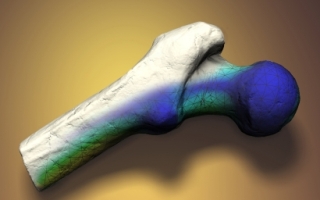
Reconstrucción 3D y análisis mediante FEM del fémur basado en las cargas durante el ciclo de marcha
Francisco Eugenio López Guerrero, Francisco Ramírez Cruz, Jorge Morales
XXVII Congreso Internacional Anual SOMIM
p.79-87, sept. 2021. ISBN 968-9173-01-4

Abstract
This work describes an analysis of the hip joint under flexion using the finite element method. To achieve this, the acquisition methodology of the bone geometry for the femur using 3D scanning was used. As result it was probed the optimal femur transition based on the homogenous stress distribution along the transition between epiphysis and diaphysis according to Neuber. An analysis was made of the stress load distribution during a normal walking cycle.


Keywords: 3D Scanner, finite element, stress distribution, femur, shape improvement.


Validación fotoelástica de modelos basados en estructuras biológicas
Francisco Ramírez Cruz, Francisco Eugenio López Guerrero, Fco. Javier de la Garza S., Luis A. Arteaga
XXVIII Congreso Internacional Anual SOMIM
p.227-234, sept. 2022. ISBN 968-9173-01-4

Abstract
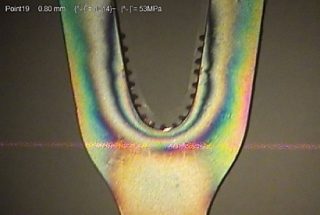
The axiom of constant stress cited by Mattheck in biological structures such as bifurcation of the branches of a tree shows a change in its geometry due to the stresses caused by the loads induced during its growth. Considering the internal contour of the bifurcation as a design area, two study models of semicircular curvature and B-Spline of third order are proposed. In this work the results are presented by means of finite elements of the distribution of stress along the curve of the fork that are experimentally contrasted with the photoelasticity technique that shows, when applying polarized light, color bands that identify the degree of deformation in the prepared specimen. The results show the homogeneity and minimization of stress product of adaptive growth..


Keywords: Photoelasticity, Finite Element, Biological Structure, Validation.


Evaluación dimensional del proceso de digitalización 3D por fotogrametría de un patrón de calibración propio
Francisco Eugenio López Guerrero, Francisco Ramírez Cruz, Sergio Alberto Cardona Ortiz, Moicés Rivera Rocha
Revista Ingenierías Año XXVI, No. 94 , Enero - Junio 2023
p. 25-41. ISSN 1405-0676

Abstract
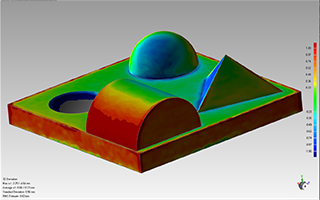
This article presents the evaluation of a 3D digitalization system using photogrammetry techniques, using as geometric reference an own-design prototype-printed Gauge block. The geometry of the Gauge block is based on the ISO 10360-6 standard, and was 3D printed with a ZCorp high quality prototype printer, with precision values known from other works. The scanning process was made using a commercial software photogrammetry application. The point cloud was processed, and the fitting curves and surfaces were made. Finally, the points cloud was compared against the CAD file. A statistical deviation analysis shows a mean error between -0.23mm to +0.60mm. The standard deviation was 0.56mm. The conclusions show a scanning process with good quality.


Keywords: Photogrammetry, 3D scanning system, ISO 10360-6, curves and surfaces fitting.